University of Ibadan VC Warns Against Political Abuse of State Policing
The Vice-Chancellor of the University of Ibadan, Professor Kayode O. Adebowale, has warned that any move to establish state police in Nigeria must be handled with caution to prevent political abuse, jurisdictional conflicts, and threats to democratic governance.
 Philip22

The Vice-Chancellor of the University of Ibadan, Professor Kayode O. Adebowale, has warned that any move to establish state police in Nigeria must be handled with caution to prevent political abuse, jurisdictional conflicts, and threats to democratic governance.

Professor Adebowale gave the warning while declaring open a one-day roundtable organised by the TETFund Centre of Excellence in Security Management in partnership with the Development Agenda for Western Nigeria Commission.
The Vice-Chancellor said the debate over state policing has moved beyond whether Nigeria should adopt it, stressing that the real issue now is how such a system can be implemented responsibly with adequate constitutional and institutional safeguards.
According to him, Nigeria’s current centralised policing structure has become overstretched and increasingly ineffective in addressing the country’s growing security challenges, including banditry, kidnappings, communal violence, piracy, insurgency, and separatist unrest.
He noted that the Nigeria Police Force, with fewer than 400,000 officers serving a population exceeding 200 million people, is burdened by manpower shortages and bureaucratic delays that weaken emergency response and local security operations.
Professor Adebowale stated that the present arrangement, where commissioners of police in states depend heavily on directives from Abuja, has slowed operational efficiency and limited local responsiveness to security threats.
He identified potential advantages of state policing to include faster local response times, improved intelligence gathering, stronger accountability, and reduced pressure on federal security agencies.

The Vice-Chancellor cited the South-West regional security outfit, Amotekun, as an example of how locally driven security initiatives can complement federal policing efforts.
However, he warned that without proper safeguards, state police structures could become political tools in the hands of governors and be used against opposition figures or minority groups.
Professor Adebowale proposed constitutional amendments to establish a two-tier policing structure comprising federal and state police systems, supported by independent police service commissions and civilian oversight mechanisms.
He also recommended harmonised operational training, community-based policing models, and collaborative funding arrangements involving both federal and state governments.
As part of a phased implementation strategy, he proposed pilot schemes in six states, one from each geopolitical zone, before any nationwide rollout.
The Vice-Chancellor further urged participants at the roundtable to develop a draft implementation blueprint on state policing for submission to the National Assembly, the Nigeria Police Council, and the Nigeria Governors’ Forum.
Delivering the lead presentation at the event, former presidential candidate and Chief Executive Officer of Motherhood Consulting Ltd, Adesina Ayodele Fagbenro-Byron, described state policing as a strategic national necessity rather than a mere academic debate.
He argued that insecurity in Nigeria has evolved into a complex national crisis involving terrorism, insurgency, banditry, kidnapping, organised crime, and cyber-enabled criminal activities.
According to him, the South-West can no longer assume immunity from violent insecurity and must urgently develop a regional, intelligence-driven, and professionally managed security framework.

Dr Fagbenro-Byron identified ownership, management, and operational control as major limitations of the existing policing structure.
He advocated constitutional reforms, technology-driven policing, intelligence-based operations, community participation, and operational capacity development as critical pillars for implementing state policing successfully.
Speaking earlier, the Director of the TETFund Centre of Excellence in Security Management, Benjamin Adeniran Aluko, said the roundtable was convened to generate practical recommendations on constitutional state policing in Nigeria.
He disclosed that the initiative followed consultations between the Centre and the DAWN Commission on the need for broader discussions on decentralised policing and security reforms.
Professor Aluko added that recommendations from the roundtable would be forwarded to governors and regional leaders in the South-West for further consideration and policy action.
Also speaking, the Director-General of the DAWN Commission, Seye Oyeleye, said the Commission has consistently advocated community and state policing as part of efforts to strengthen regional security architecture.
He stated that the current centralised policing model has become overwhelmed by the scale and complexity of insecurity across the country.
According to him, state policing represents a long-standing aspiration for greater local control over security management and community safety.
The roundtable, themed “Constitutional State Policing in Nigeria: Opportunities, Challenges and Implementation,” featured a panel discussion moderated by Professor I. O. Albert of the Department of Peace, Security and Humanitarian Studies, University of Ibadan.
Panelists included Professor Akin Alao of Obafemi Awolowo University, Dr Anthony Oyedeji, Professor Adesina Afolayan, Dr Temitope Bello, Barrister Mutalubi Ojo Adebayo (SAN), retired Commissioner of Police Fatai Owoseni, and Mr Wale Adeoye.
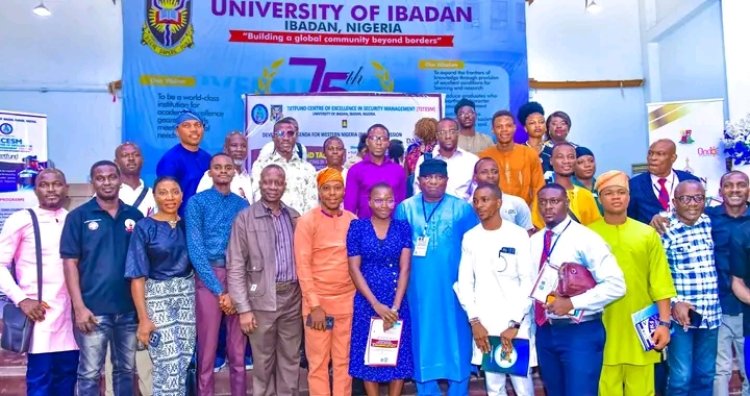
The event attracted academics, security experts, civil society leaders, and policy advocates who examined both the prospects and risks associated with constitutional state policing in Nigeria.