From Crumbling Classrooms to Digital Learning: How Ekiti’s N9.7bn Education Investment Is Reshaping Public Schools
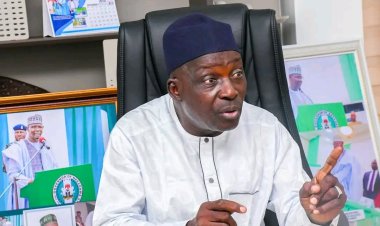
The Ekiti State Government has invested over N9.7 billion in counterpart funding to the Universal Basic Education Commission (UBEC) between 2022 and 2025 under Governor Biodun Oyebanji’s administration. According to SUBEB Chairman, Prof. Femi Akinwumi, the investment has significantly improved public basic education across the state.
 judithhh
Education is often described as the foundation of development, but in many parts of Nigeria, public basic education continues to struggle with poor infrastructure, inadequate teaching materials, and a shortage of qualified personnel. In Ekiti State, however, a bold financial commitment appears to be changing that narrative.
The Ekiti State Government has revealed that it invested more than N9.7 billion in counterpart funding to the Universal Basic Education Commission (UBEC) between 2022 and 2025 under the administration of Governor Biodun Oyebanji. According to the Chairman of the State Universal Basic Education Board (SUBEB), Prof. Femi Akinwumi, the massive investment is already producing measurable improvements across the state’s public primary education system.
Speaking in Ado Ekiti, Akinwumi disclosed that the government paid N1.2 billion in 2022, N1.39 billion in 2023, and N3.55 billion each in 2024 and 2025 as counterpart funds to UBEC.
According to him, the intervention has transformed teaching and learning conditions in public schools by improving infrastructure, increasing access to education, boosting enrolment and retention rates, and reducing the number of out-of-school children.
One of the most visible impacts of the investment has been the large-scale renovation of school buildings. Akinwumi stated that 699 classroom blocks have been renovated since 2022.
The breakdown includes:
- 208 classroom blocks renovated in 2022
- 168 in 2023
- 161 in 2024
- 162 in 2025
In addition, 106 classroom blocks are currently undergoing renovation or fresh construction across the state.
For many pupils and teachers, this means a shift from dilapidated classrooms to more conducive learning environments designed to improve concentration, attendance, and academic performance.
The government’s intervention extends beyond buildings. Between 2022 and 2025, SUBEB procured:
- 8,410 pieces of pupils’ furniture
- 1,447 pieces of teachers’ furniture
These upgrades are aimed at improving classroom comfort and supporting better learning outcomes.
The state also invested heavily in school sanitation and healthcare infrastructure. A total of 59 boreholes have been constructed in schools since 2022, providing access to clean water and supporting better hygiene practices.
Additionally, 41 perimeter fences were built to strengthen school security and create safer environments for pupils and staff.
Recognizing that quality education depends heavily on teacher effectiveness, the Ekiti State Government also prioritized staff development.
According to Akinwumi, 8,336 teachers benefited from capacity-building programmes between 2023 and 2026, while 355 caregivers were trained during the same period.
The administration also focused on staff recruitment and welfare:
- 1,500 teachers were recruited in 2023
- 200 non-teaching staff were employed
- 362 security guards were recruited in 2024 to improve school safety
Promotion and welfare packages were also expanded. Akinwumi revealed that 7,178 primary school teachers have been promoted since 2022.
In what he described as a historic achievement, 259 teachers on Grade Level 15 were elevated to Grade Level 16 in 2025.
To ensure schools function effectively, the government released more than N860 million as running grants to public primary schools since 2022.
Another N182.3 million was spent on instructional materials to improve classroom teaching resources.
Teachers also benefited from financial support schemes. A total of N268 million was disbursed under the staff housing and vehicle loan scheme for primary school teachers. Governor Oyebanji has also approved an additional N200 million to recapitalise the programme.
The scale of Ekiti’s investment highlights the critical role counterpart funding can play in unlocking federal education support and improving public school systems.
Beyond infrastructure, the state’s approach combines teacher welfare, security, digital literacy, sanitation, and learning materials — a broader strategy that education experts often argue is necessary for sustainable improvement.
While challenges in Nigeria’s education sector remain significant, Ekiti’s experience may offer an example of how consistent funding and targeted interventions can gradually transform public education outcomes.
For thousands of pupils across the state, the impact is already becoming visible — from renovated classrooms and cleaner school environments to better-trained teachers and improved access to learning resources.