FUNAAB Convocation Lecturer Calls for Reinvention of Agriculture as Nigeria’s Engine of the Future of Work
Nigeria’s quest for sustainable employment, inclusive growth and long-term national resilience lies in the deliberate reinvention of agriculture as a coordinated, system-driven engine of work, rather than in anxiety over automation and artificial intelligence.
 Philip22

Nigeria’s quest for sustainable employment, inclusive growth and long-term national resilience lies in the deliberate reinvention of agriculture as a coordinated, system-driven engine of work, rather than in anxiety over automation and artificial intelligence.

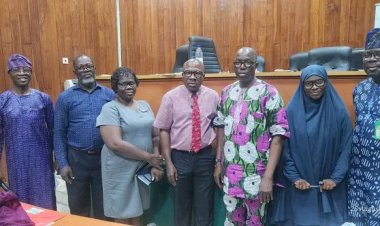
This was the central thesis advanced by renowned banker, investor and philanthropist, Barrister Aigboje Aig-Imoukhuede, CFR, at the 33rd Convocation Lecture of the Federal University of Agriculture, Abeokuta (FUNAAB).
The lecture, held on January 30, 2026, at the University’s Red Chamber, was delivered under the theme “Agriculture, the Future of Work, and the University as Catalyst.” It formed a major intellectual highlight of the convocation ceremonies and further reinforced FUNAAB’s growing profile as a thought leader at the intersection of agriculture, governance and national development.
Addressing policymakers, academics and graduating students, Aig-Imoukhuede challenged prevailing narratives that frame agriculture narrowly as subsistence farming. He argued that, when properly governed and coordinated, agriculture represents Nigeria’s most scalable platform for dignified employment, innovation and structural transformation.
“While global debates on the future of work are dominated by automation and artificial intelligence,” he said, “Africa’s more urgent challenge is the creation of productive, sustainable and large-scale employment for its youthful population. Agriculture offers a unique comparative advantage in this regard.”
According to him, agriculture is a complex, integrated system that cuts across science, engineering, logistics, finance, technology, regulation and trade. “No other sector,” he noted, “matches its capacity to generate jobs across skill levels, income bands and rural–urban divides while simultaneously strengthening food security and national resilience.”

Drawing lessons from the biblical account of Joseph in Egypt and Brazil’s agricultural transformation, Aig-Imoukhuede stressed that agriculture becomes transformative only when treated as a coordinated system rather than a collection of isolated interventions. Turning to Nigeria’s experience, he observed that despite vast arable land, human capital and a large domestic market, the country remains a net food importer largely due to weak coordination.
“Nigeria’s agricultural story is not one of failure,” he said, “but one of unfinished architecture.”
He urged graduates to view agriculture as a modern, technology-enabled and value-chain-driven career space, noting that the most significant employment opportunities lie beyond the farm gate—in storage, processing, logistics, quality assurance, branding and export markets. He cautioned, however, against an over-reliance on technology without strong institutions and governance, emphasizing that sustainable transformation requires patient capital, credible systems and consistent leadership.
Addressing the graduating class directly, Aig-Imoukhuede called for adaptability, lifelong learning and civic responsibility, reminding them that Nigeria’s future depends on builders of systems rather than spectators.
Earlier, the Vice-Chancellor of FUNAAB, Professor Babatunde Kehinde, welcomed guests and described the Convocation Lecture as a celebration of excellence, scholarship and institutional pride. He noted that the lecture series remains a defining intellectual tradition of the University, providing a platform for critical engagement with pressing national and global challenges, while reaffirming FUNAAB’s commitment to innovation and national development.
The lecture was chaired by the Chairman of the Federal Civil Service Commission, Professor Tunji Olaopa, who called for a fundamental rethinking of Nigeria’s university education system, particularly universities of agriculture. He urged such institutions to align more deliberately with national development priorities and the aspirations of Nigerian youth, warning that rising unemployment and unemployability pose serious risks to social stability and national cohesion.
Professor Olaopa advocated a balanced educational model that combines manpower development with character formation. He also urged universities to embrace emerging technologies—such as artificial intelligence, robotics, drones, GIS and the Internet of Things—to drive smart agriculture and innovative agribusiness. He further called for sustainability-driven research, innovation hubs and community-focused solutions, especially for rural development.
In his concluding remarks, he identified key reforms needed to reposition Nigeria’s university system, including greater institutional autonomy, improved funding through public–private partnerships, and a more developmental approach to industrial relations.

The 33rd Convocation Lecture thus underscored FUNAAB’s role as a global knowledge hub and catalyst for ideas capable of reshaping agriculture, governance and the future of work in Africa, while firmly positioning the University at the forefront of debates shaping Nigeria’s long-term development trajectory.